
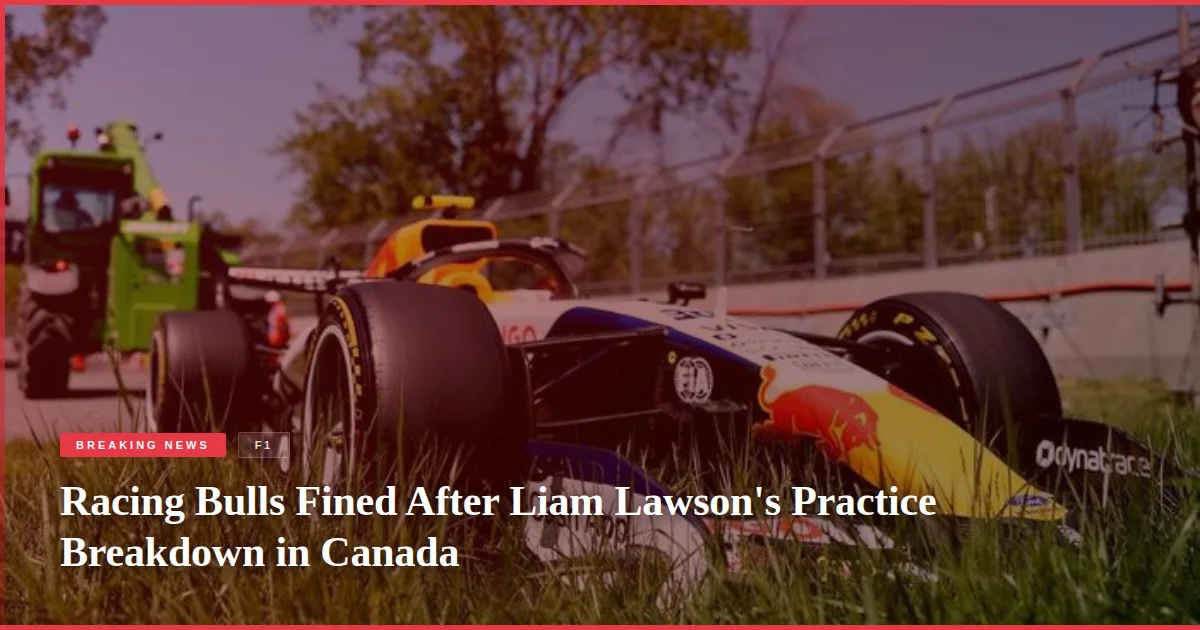
Racing Bulls have been hit with a €30,000 fine following Liam Lawson’s breakdown during practice for the Canadian Grand Prix. The FIA’s stewards communicated their displeasure in the document announcing the fine. Lawson’s car stopped on track with a hydraulic issue within 10 minutes of the practice session, leading to a red flag.
Hydraulic Failure and Red Flag
Lawson’s car halted with a hydraulic problem early in the practice session. Marshals were unable to move the car. The Circuit Gilles Villeneuve, being an older venue, lacks the space for perimeter roads, complicating the removal of stricken cars.
All cars are required to have a Clutch Disengagement System (CDS). This system should allow marshals to move the car even if the hydraulics and electrics have failed. The VCARB 03 should have been pushed into a gap in the barriers while under a virtual safety car deployment. Instead, the session was red-flagged, and race control added five minutes to the end to compensate.
FIA’s Fine and Technical Concerns
Racing Bulls was fined €30,000 for breaching Article C9.3 of the FIA F1 Regulations. €20,000 of the fine is suspended for 12 months, pending no further breaches of the regulation by either of their cars. FIA technical delegate Jo Bauer had previously warned Racing Bulls about its CDS design. The design is unusual because it also services the car’s anti-stall system.
Article C9.3 states that all cars must have a way to disengage the clutch for at least 15 minutes if the car stops with the engine off. The system must work throughout the competition, even if the main hydraulic, pneumatic, or electrical systems have failed. The system is activated by a clearly marked button, located on the monocoque so it can be reached within five seconds by the driver or marshals.
CDS Failure and Safety Hazard
The marshal who initially tried to activate the CDS was trying to press a button in the wrong place. However, the CDS system had failed regardless. The stewards were clearly annoyed by this. It prevented the car from being moved and disrupted the session. It also created a safety hazard because the CDS is supposed to shut off the car’s electrical energy recovery system.
The stewards’ statement noted that the system performs two roles. It is intended to release the clutch when the car is stopped and the engine is not working. It also relates to the car’s electrical energy recovery system.