
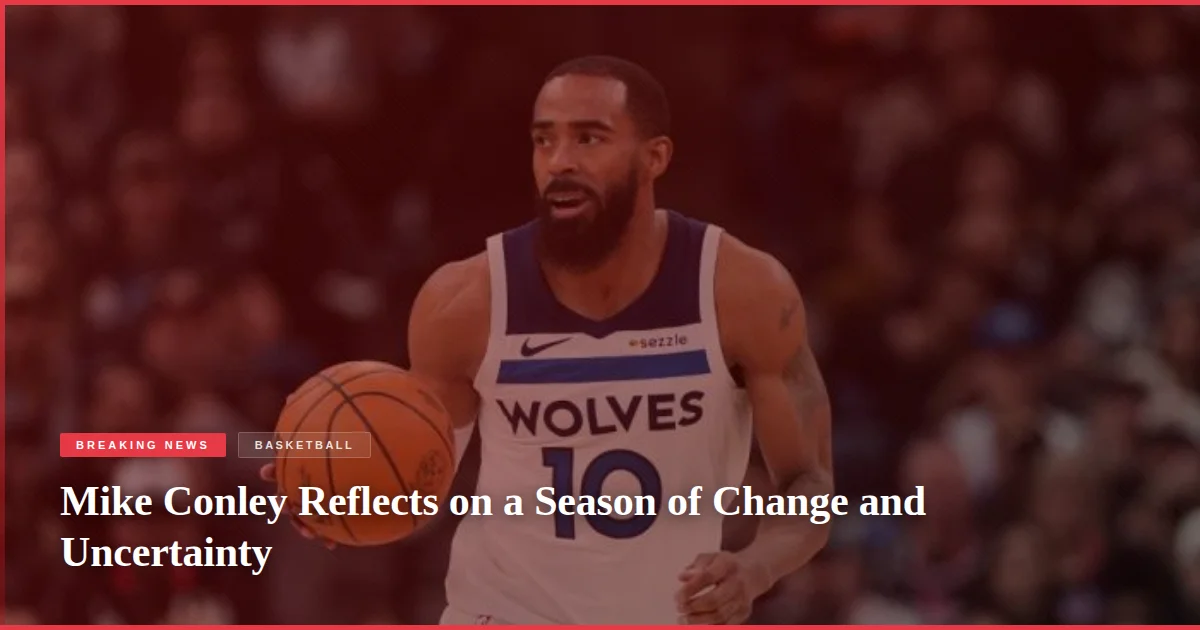
Mike Conley considers himself a rhythmic player who always tries to gauge the rhythm of the game. He aims to identify what the team needs in the moment to succeed. This approach has made him one of the game’s elite floor generals.
However, Year 19 has been a campaign filled with constant change for the veteran guard. This included an unexpected move to the bench at the season’s start, followed by a trade, a re-signing and sporadic role changes.
Unexpected Trade to Chicago Created Uncertainty
Conley said he never really got comfortable in any situation. “To start off the year not starting, it was new, it was different,” Conley said. “As the season went on, it was like I’m not playing the best, not playing consistent minutes – sometimes it’s 12, sometimes it’s 22. Sometimes I start. Every other night was different, playing with different units and different guys. It was just a bunch of stuff happening.”
The biggest thing that happened was a trade, which Conley said was “the last thing I thought about” in February. A deal landing him in Chicago momentarily left him in no man’s land, as he felt a rebuilding squad certainly wasn’t the right fit.
“It was scary,” Conley said. “It was definitely scary.”
Understanding the Business Side of Basketball
Conley recognised the precariousness of his situation, acknowledging that it could have gone in any direction. He could’ve rotted away in Chicago, or been re-routed to a different team that didn’t play him, which is frequently a career ender.
“It still was like initially, ‘Damn, I see how it is,’” Conley said. “It’s one of those things where no matter how much you leave the team or management – love Tim (Connelly), love coach – it’s still like, ‘Damn, y’all traded me, sent me to an unknown situation.’ But I don’t even look at it as a bad thing. I understand it’s a business. I’ve been fortunate enough where you have your relationships with management, you have your relationships with coaches, but I’ve always kept it as a business at the end of it. I understand you’ve got to look out for the team and they try their best to look out for you, especially here. Tim does a great job of trying to do what’s right by the player. In my place, it ended up working out great.”
Accepting a Reduced Role and Planning Ahead
A strength of Conley’s is putting himself in the shoes of others when analysing a situation. When Minnesota drafted Rob Dillingham in 2024, he knew that meant some of his playing time would need to be re-allocated. When the Wolves traded for Ayo Dosunmu and Bones Hyland started playing well, Conley knew his pre-trade minute load may no longer be available.
“From the beginning, I told coach, ‘I get it, keep rolling with what you’ve got, no big deal.’ And we did,” Conley said. “I’m a realist. I’m in Year 19. I’m not in Year 10, so it’s not the same situation. I don’t blame coach, I don’t blame Tim, I don’t blame anybody for the way that I’ve just been thrown around.