
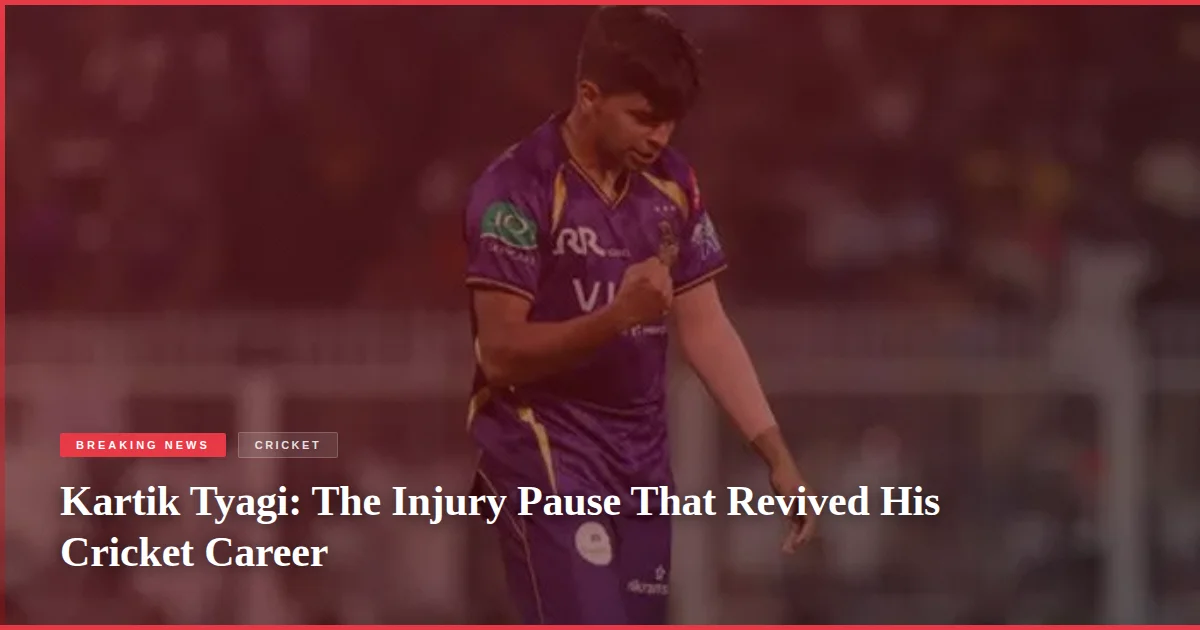
In the summer of 2024, Kartik Tyagi made the difficult choice to step away from competitive cricket indefinitely. The decision came after a challenging period, as the reality of his situation made it an obvious call.
Recurring Injury Issues
Between December 2023 and May 2024, Tyagi only played in 10 top-level matches. The years leading up to that point were also difficult. A recurring shin splints issue, which first appeared in 2021, continued to plague him. Despite regular rehab, he only made six IPL appearances between the 2022 and 2024 seasons.
“I just couldn’t play big matches. I couldn’t bowl too many overs in practice. It was getting difficult for me especially in 50-over and first-class games. So that gave me a lot of problems,” Tyagi told Cricbuzz before IPL 2026.
Ahead of the 2024 IPL, Tyagi planned to address the shin splints after the tournament, but he also sustained a side strain. He played in one game for the Gujarat Titans that year, conceding 0/51 against Chennai Super Kings. “It was very difficult, and that’s when I understood that I should treat it properly first.”
Taking a Break to Recover
Tyagi then decided to pause his career. From May 2024, he would not play another top-level game for 19 months. He sought the help of Ashish Kaushik, formerly the Head Physiotherapist of the National Cricket Academy (now Centre of Excellence) in Bengaluru, who had known Tyagi since his U19 days. Kaushik focused on the length of his run-up, the angles he created, and “restoring efficiency in that”.
Remodelling His Bowling Action
Tyagi has a history of remodeling his bowling action to reduce the strain on his body. This time, the focus was on an excessive out-jump in his load-up and the movement of his non-bowling arm. However, there were other factors to consider.
“Stress injuries are much better understood now, but to break it down in layman terms, it is spending more than you have,” Kaushik says. “But the question remains: why did this happen?”
The length of Tyagi’s run-up and the way he was running in were identified as the cause. The recurrence of the injury led him to shorten his run-up. “Finally he’s buckled,” Kaushik said, adding that Tyagi had matured and gained a better understanding of his body.
Despite being a natural at speeds over 145 kph, shortening his run-up was not expected to affect his pace. “Sometimes you get ready (to clock that pace) five steps before actually getting to the crease,” says Kaushik. “You’re wasting those five steps because you’re actually ready and it creates fatigue over time. And a higher risk of injuries.”
Psychological Challenges
Navigating a long period on the sidelines was mentally challenging for Tyagi. The support of his family and Kaushik was crucial in keeping him motivated.