
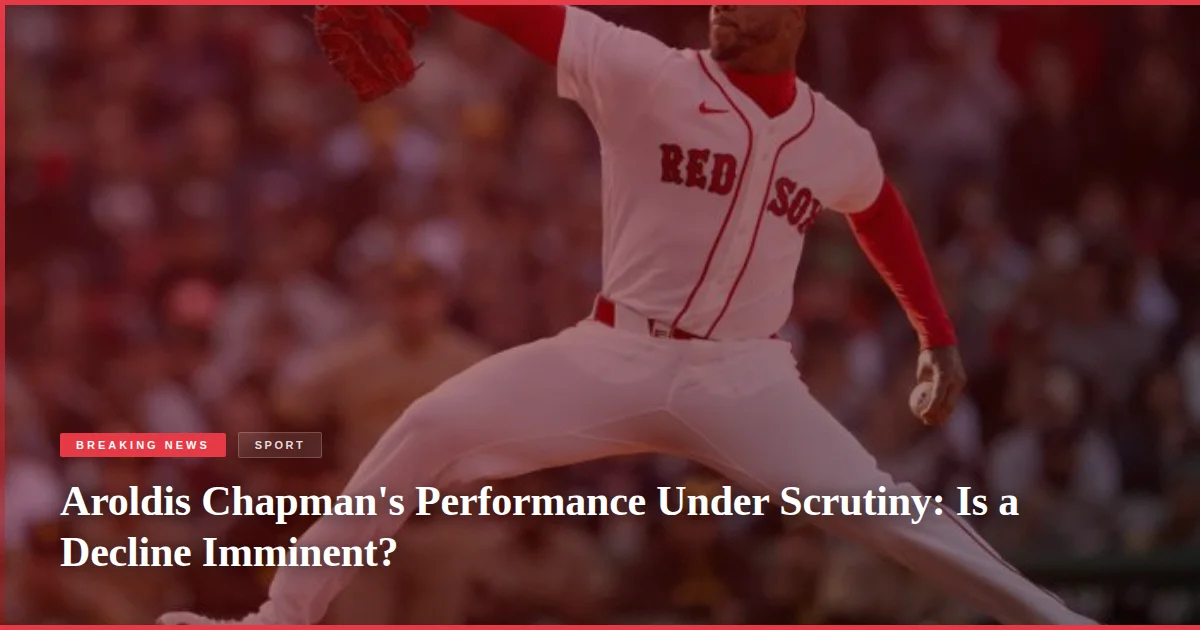
Aroldis Chapman’s tenure with the Red Sox has been impressive, marked by a 1.22 ERA and 35 saves in 37 opportunities. Despite this, concerns are emerging about the sustainability of his performance. The question is: when will Chapman’s performance decline?
Slower Fastball Raises Eyebrows
Chapman’s fastball velocity has come under scrutiny. He recently threw his slowest fastball as a Red Sox player at 90.8 mph. Given his reputation as a premier flamethrower since 2010, this slower pitch is a talking point. He has thrown over 10,000 fastballs since 2010.
Analysing Chapman’s Effort and Velocity
Chapman’s fastball velocity appears to vary depending on the game situation. There’s a jump of about two miles per hour with his fastball when he gets to two strikes. He brings out his best stuff in those counts. The magnitude of the effect has increased with age.
His relative effort changes with the score as well. In a one-run game, Chapman throws his fastballs significantly harder than in a three-run game or when trailing. The effect isn’t as significant here, but it does exist. There isn’t much of a difference between tie games and two-run games, but if the winning or tying run is at least in the on-deck circle, Chapman brings it.
Warm-Up Impact on Pitch Velocity
It typically takes Chapman about four pitches before he appears to be warm. His average fastball velocity increases as his outing progresses. When he throws a fastball for his first or second pitch of the outing, it averages about 97 mph. By the time he gets to his seventh pitch, the average velocity is up to 99 mph.
One potential issue is that the first and second pitches of an outing can never be a two-strike count. It has already been noted that he turns it up with two strikes. By the time we’re five or so
Chapman has been in the league since 2010. At 38 years old, it’s fair to see 90 mph and wonder if he’s over the hill.