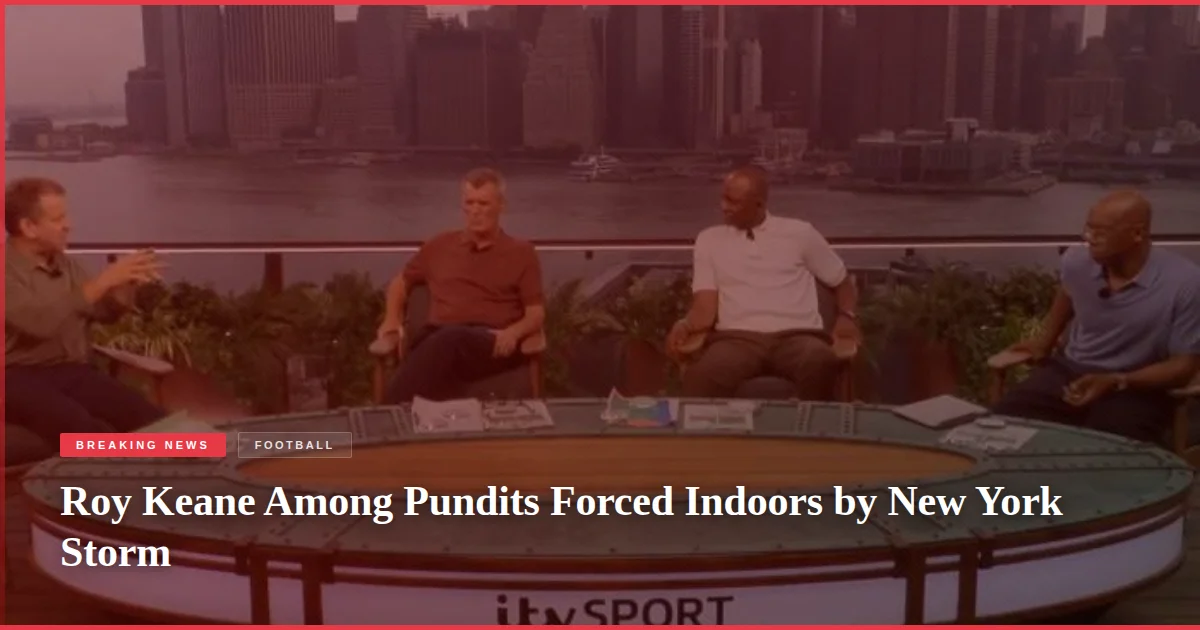
Roy Keane, the well-known football pundit, was among the ITV World Cup panel forced to abandon their outdoor rooftop studio in New York, as severe weather conditions struck the city during live coverage. The former Republic of Ireland captain, alongside fellow pundits Ian Wright and Patrick Vieira, had been broadcasting from the British network’s New York loft location. This initial setup, featuring the panel outdoors, had to be swiftly vacated after adverse conditions developed, leading to a relocation indoors to an alternative space.
Storm Disrupts Live Broadcast
The unexpected studio change was announced by ITV anchor Mark Pougatch, who informed viewers of the necessity to move inside. This update came as coverage resumed following an interview with England star Djed Spence. Pougatch’s explanation highlighted the specific reason for the enforced relocation: lightning strikes in the New York area. He stated: “There’s lightning in the area in New York, so the regulations dictate we’ve had to vacate our outdoor studio, so we’ve moved inside.” While the ITV team in New York faced these challenging conditions, the weather remained pleasant in Boston, where France were scheduled to play Morocco in a World Cup quarterfinal. Ahead of this significant match at Boston Stadium, Morocco fans were observed to be extensively donning Palestine flags. ITV, therefore, adapted their broadcast by exchanging their cloudy outdoor setting for a sleek indoor alternative to ensure uninterrupted coverage.
Pundits Praise Brooklyn Studio Views
ITV’s main World Cup studio operates from Panorama Brooklyn Studios on Columbia Heights, a location chosen for its extensive and sweeping views. The facility provides a striking backdrop for the live broadcasts, showcasing Manhattan’s iconic skyline, the Brooklyn Bridge, and the East River. This specific venue has an interesting history, occupying what was once a Jehovah’s Witnesses headquarters before its transformation into a modern production facility. Despite the occasional need to move indoors due to weather, presenters and pundits alike have commended the studio that has served as their operational base throughout the World Cup tournament. Mark Pougatch, the ITV anchor, introduced the unique setting during the initial broadcast, welcoming viewers to “our New York loft apartment, home for six weeks of coverage of the World Cup.” He emphasised the authenticity of the stunning visual, adding, “We hope you will love this view as much as we do, a view of the buildings of lower Manhattan and Brooklyn Bridge. You are thinking it must be AI; I promise you it is real.” Roy Keane himself expressed his admiration for the setup, succinctly describing it as “Amazing, fantastic.” Ian Wright also conveyed his strong approval, stating, “It’s amazing, unbelievable set. It’s the World Cup, it should be this, it should be grand, massive,” underscoring the grandeur of the setting befitting the global tournament.
Recurring Weather-Related Studio Shifts
The recent incident involving Roy Keane and the ITV panel marks another occurrence during the current World Cup where the broadcaster has found it necessary to shift its production indoors. A similar situation arose last month when Laura Woods, alongside fellow pundits Juan Mata, Patrick Vieira, and Karen Carney, had to contend with particularly harsh windy conditions. This challenge occurred while they were covering Switzerland’s victory over Bosnia and Herzegovina. During that specific broadcast, production eventually moved inside later that night, prompted by the adverse weather. Observable elements of the difficult conditions included distinct clattering sounds audible in the background of the live coverage. Furthermore, Woods herself was seen having to keep her hair out of her face due to the strength of the wind. In other previous instances during the tournament, coverage for matches involving Canada and Qatar also quickly transitioned indoors. On those occasions, ITV utilised their designated backup option for segments featuring Ange Postecoglou, United States women’s manager Emma Hayes, and Bradley Wright-Phillips, illustrating a pattern of adapting to environmental factors.
In contrast to ITV’s operational strategy of basing its coverage in New York, the BBC, serving as the competing broadcaster, opted to remain in Salford for its World Cup coverage for much of the tournament. However, the BBC now appears to be poised to travel to the USA for the semi-final stage of the competition. Critically, the BBC holds the “first pick” for that particular stage of the tournament. This means that if England successfully advance in the competition, the BBC would be in a position to claim their semi-final match, where they would potentially face either Argentina or Switzerland.