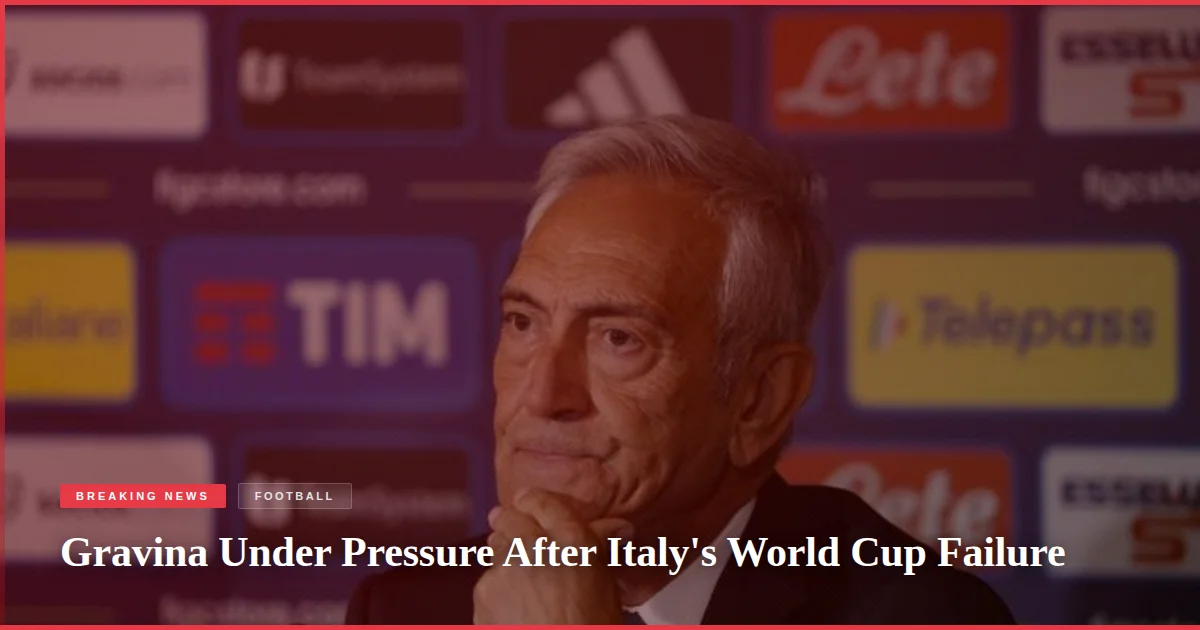
Gabriele Gravina, the president of the Italian Football Federation (FIGC), finds himself in a precarious position following Italy’s third consecutive failure to qualify for the World Cup. After previously stating, “I am a reed and I hardly break,” Gravina now faces the fiercest storm.
He is taking time to reflect and consult with the Federal Council. Many anticipate that he will step down. Gravina has always made his own decisions. However, the magnitude of the disappointment raises questions about his ability to continue.
Gravina’s Intentions and the Federal Council
In the lead-up to the playoffs, Gravina had not revealed his intentions, keeping his options open. In late November, he remarked, “If the destiny of the FIGC is linked to that of the national team? There is no rule on this, within us there is a principle of democracy, I received 98% of the preferences.” He then added, “Then there are reflections to be made, linked to choices of responsibility and of a personal nature.”
The decision now rests with him. A key factor will be his discussions with the Federal Council. He currently enjoys the confidence of practically everyone, making a vote of no confidence unlikely, though not impossible. A forced administration, based on the Coni Statute, is also less likely than it appears. Politics might intervene, but Gravina has always defended the autonomy of sport.
Past Criticisms and the Future of Italian Football
Two years ago, after a disappointing European Championship, Gravina responded to criticism and calls for his resignation by stating, “It does not exist that someone can govern our world from the outside, this applies to politics and to everyone else, in asking for the resignation of both Gravina and Spalletti. It does not exist.” He added, “I face problems with work, I do not run away from the responsibilities that concern me.”
He also said, “I keep the political difficulties separate from the technical ones and the game in which the sobbing victors revel, does not interest me. The sense of responsibility on my part calls for a sense of clarity, that is, not to put into practice acts that determine damage greater than what there is now.”
Gravina had initiated his football reforms, which have now taken solid shape. However, the choice to continue with Spalletti is now seen as a mistake. Regarding “damage greater than what there is now”, some might consider the upcoming European Championships that Italy is set to host in 2032. Ceferin supports him, as evidenced by his presence at the stadium, and having the backing of the UEFA president is always beneficial.
Even four years ago, following the defeat to North Macedonia and Italy’s second World Cup exclusion, Gravina was in a similar position.