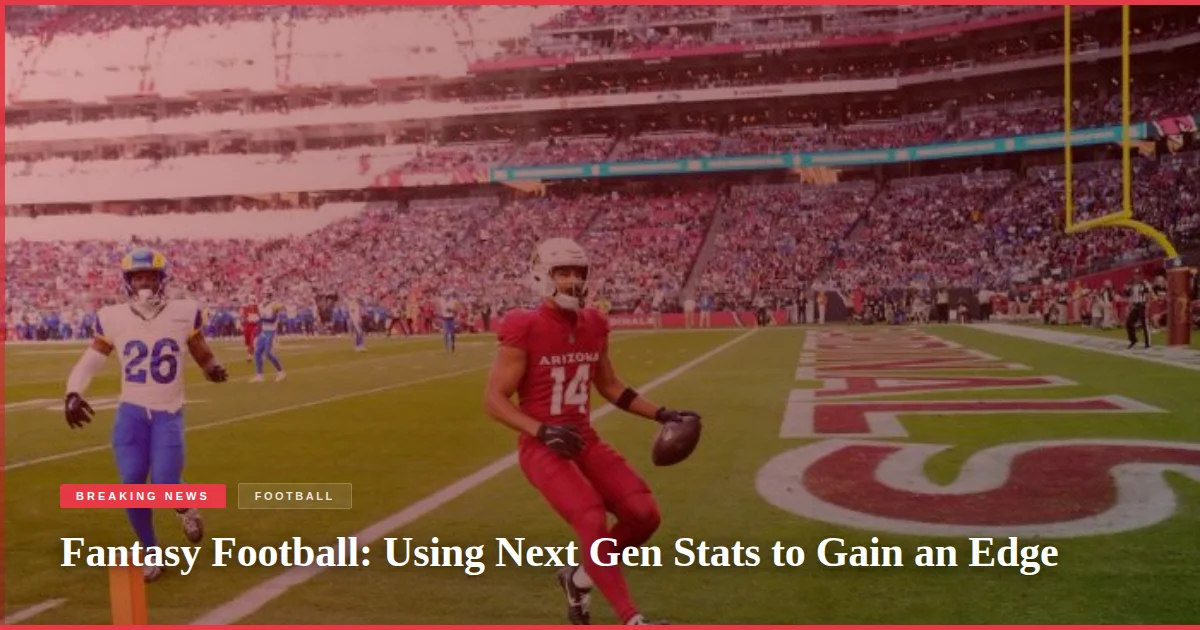
Fantasy football wide receiver production may seem straightforward, but raw target and yardage totals can be misleading when evaluating a player’s true fantasy value. Next Gen Stats can help show whether a receiver earned high-value opportunities, created extra yardage after the catch, or simply benefited from an efficient period.
These advanced metrics, used alongside standard stats, give a fuller picture of a receiver’s fantasy outlook, helping managers to identify stable roles versus inflated ones.
Evaluating Receiver Roles with Expected Fantasy Points
xFP is a key starting point, capturing the fantasy value of a receiver’s role rather than just target numbers. A player with fewer, higher-quality targets can outperform a receiver with more overall volume. This stat helps fantasy managers identify workloads strong enough to support stable WR value.
The Importance of Downfield Targets
Downfield targets are a vital indicator for fantasy receivers. They create bigger gains, more touchdowns, and more week-winning outcomes than short-area volume. While a receiver with strong air-yard usage may be less consistent weekly, this role can swing matchups from WR3 or flex spots.
YAC: Playmaking vs. Easy Touches
Expected YAC shows what the offense set up for them, while YAC over expected shows what they added on top of it. This helps identify players whose fantasy value is built on real playmaking. Some players merely live off screens, shallow crosses, or easy touches.
Spotting Anomalies with Fantasy Points Over Expectation
FPOE helps fantasy managers spot anomalous seasons and potential buy-low opportunities. A receiver who exceeded expectations may have benefited from extreme touchdown efficiency or an unsustainable deep ball hit rate. Conversely, a receiver below expectation may have better underlying value, especially if their role remained strong.
Understanding Target Quality
This context helps explain target quality. A receiver with decent volume may still have a weak weekly floor if many targets are difficult or low-percentage throws. A player tied to strong catchable volume may be safer than raw totals suggest. It is a useful lens for judging consistency.
Route Recognition and Long-Term Trust
Route Recognition helps fantasy managers understand whether production came from a stable receiving role or a narrower, more volatile deployment. A receiver with a fuller route portfolio is often easier to trust long term than one whose fantasy value depends on a small number of specific looks or one type of target.
- xFP captures the fantasy value of a receiver’s role rather than just target numbers.
- Downfield targets create bigger gains and more touchdowns.
- YAC over expected shows what players added on top of what was expected.
- FPOE helps fantasy managers spot anomalous seasons and potential buy-low opportunities.
By understanding these metrics, fantasy football managers can better assess receiver roles and manage risk effectively.