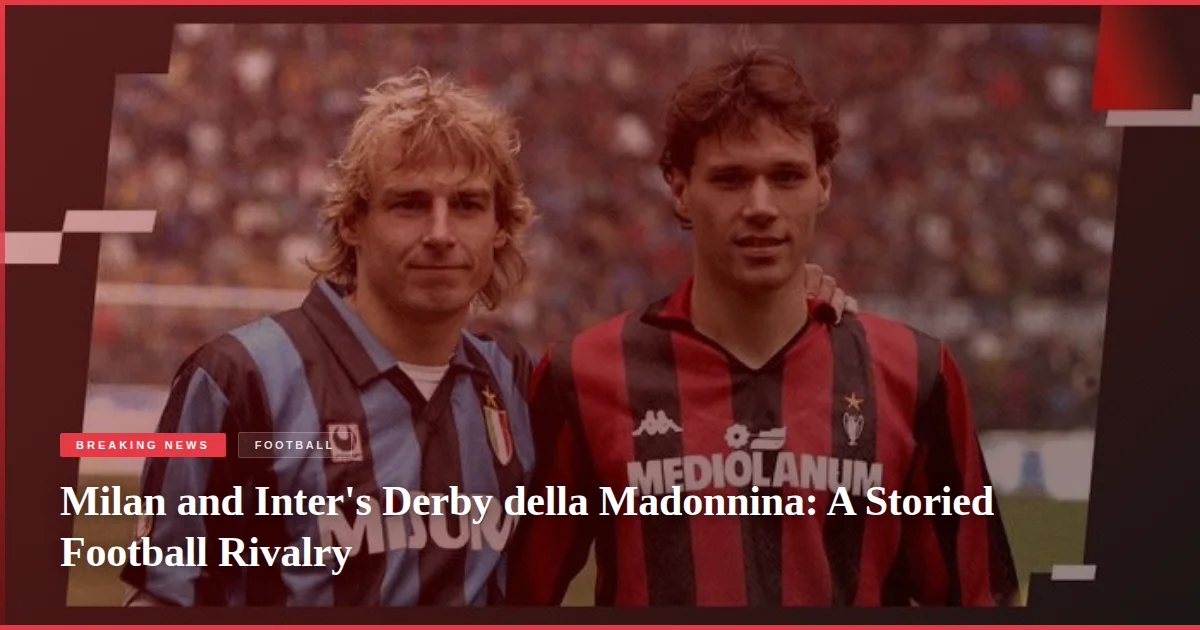
Few football matches possess the aesthetic, political and sporting weight of the Derby della Madonnina. Named after the statue of the Virgin that crowns the Duomo of Milan, the clash between Inter and Milan is the only city derby in Europe boasting two European champions sharing the same ground and stadium.
In 2026, with both teams regaining their contender status in Serie A, the history of this clash is gaining absolute relevance once again.
The Origins of a Sporting and Social Divide
The genesis of the conflict dates back to 1908, when a faction of Milan decided to separate and found Internazionale, under the premise of accepting foreign players without restrictions. That division was not only sporting, but social: historically, Inter was the club of the Milanese bourgeoisie, while Milan represented the working class.
Today, although those social boundaries have blurred, the identity of each side remains intact in the stands of the Giuseppe Meazza.
Milan and Inter’s European Dominance
There was a decade when the throne of European football did not leave the city limits. During the sixties, Milan and Inter established a hegemony that transformed the European Cup into a Milanese affair. Milan led the way in 1963, breaking the Iberian dominance with Nereo Rocco and the elegance of Gianni Rivera.
However, Inter’s response was immediate and forceful: under the tactical direction of “the Wizard” Helenio Herrera and the display of Sandro Mazzola, the Nerazzurri side conquered the continent consecutively in 1964 and 1965.
That period not only filled the trophy cabinets, but forged the identity of both clubs: the attacking vocation of Milan versus the tactical discipline and lethal counterattack of Inter.
The Glamour Era of the Derby della Madonnina
During the 1980s and 1990s, the Derby della Madonnina stopped being a local affair and became the most glamorous spectacle on the planet. Milan, driven by Arrigo Sacchi’s tactical revolution and the power of the Dutch trio (Van Basten, Gullit and Rijkaard), redefined modern football with suffocating pressure and a dominant attacking vocation. Inter responded by building an identity based on solidity and character, personified in the German backbone and, later, in the global impact of Ronaldo Nazário.
In those years, the derby brought together the main figures of international football. Although Juventus and Napoli were also competitive, Inter and Milan were the main classic on the planet. In the era of globalisation and the internet, those duels would be as remembered as the Real Madrid-Barcelona matches of the 2000s.
The Shared Colosseum of San Siro
To understand the magnitude of this clash, it is necessary to review the pillars that sustain it.
- San Siro: the shared coliseum.
Playing in the same stadium generates a unique mystique; the home dressing room changes ownership every week, but the tension in the tunnel is a constant.