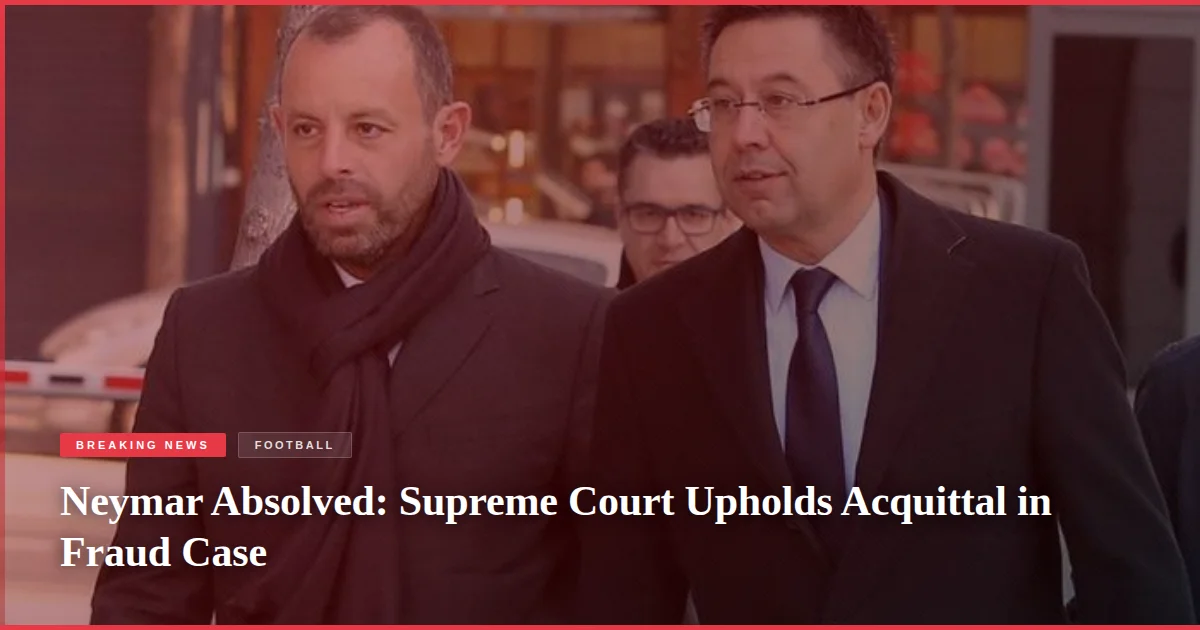
The Supreme Court has upheld the acquittal of Neymar Da Silva Santos Júnior, FC Barcelona, former FC Barcelona presidents Sandro Rosell and Josep Maria Bartomeu, and Santos in a case involving alleged corruption in business and improper fraud related to his signing in 2013. The court rejected the appeal presented by the company DIS.
DIS’s Appeal Rejected
DIS, the claimant in the case, had acquired the economic rights derived from Neymar’s federative rights on March 6, 2009, when he was a player for Santos Futebol Clube. DIS paid five million Brazilian Reals for these rights.
The lawsuit alleged that FC Barcelona made an agreement with the player, promising a sum of money if he signed for them when he became a free agent. DIS believed this sum should have been included in their economic rights, entitling them to compensation.
The club aimed to ensure Neymar would sign with them in 2014. However, the club brought forward the signing to 2013 and paid a transfer fee. DIS received its share of this fee. The Supreme Court stated in its 120-page document that:
- A key factor in the final decision was that DIS, despite holding 40% of the economic rights, did not hold the federative rights. These rights allow a player to sign for a different team while still under contract with another club.
- According to FIFA regulations, the federative rights are not transferred until the selling and buying clubs agree. This transfer results in the player changing clubs.
- DIS “acquired on March 6, 2009, the economic rights derived from the federative rights of the professional football player Neymar Da Silva Santos Junior, who at that time belonged to the Santos Futebol Clube squad. In exchange for the acquisition of these rights, DIS paid him five million Brazilian Reals.”
- DIS received €6,840,000 for the transfer of the player from Santos Futebol Clube to Futbol Club Barcelona, which was 40% of the €17,100,000 transfer price.
No Evidence of Fraudulent Intent
The compensation for the player’s transfer is paid to whoever holds the economic rights. The Supreme Court found no evidence to infer that the prior contracts were carried out to conceal a fraudulent intention.
The court stated that there was no evidence of fraudulent intent in the contracts.
The Supreme Court confirmed the previous ruling, absolving Neymar and the other defendants of the charges.